
Building internal motivation...

...to learn.

Hello all. Welcome to the 151st edition of TEPS Weekly!
Every teacher has likely faced a classroom where, despite their best efforts, the atmosphere feels dull. The teacher finds blank faces, and students hardly raise their hands. The only hands raised are from students asking what exactly they need to memorise for the upcoming exam. There seems to be no thrill of discovery or building of deep conceptual understanding. When this happens, it is natural for a teacher to question why their carefully planned lessons and resources have failed to engage their students.
The answer might not always lie in the teacher’s efforts. It might lie in how humans learn. Learning requires energy – but the human brain wants to conserve energy. So, learning becomes an endeavour that requires will or motivation.
[To learn more about how learning happens in the brain, enrol in the online, self-paced TEPS Course Whole-Brain Learning.]
Understanding Motivation
The Self-Determination Theory or SDT is a popular theory to understand what motivates people to grow. At its heart, motivation is the spark that pushes one to work toward a specific goal. Now, this motivation can be driven from two opposite sources: a person can work because they are self-driven (internal) or because they feel pressured by outside forces or rewards (external). For example, a student may study because they are interested in the subject or because they feel pressured to get good grades.
So, we need to not just think about whether a student is motivated, but also about the source that drives the motivation. The source will lie on a range from being completely external to being completely internal, as shown in the figure.
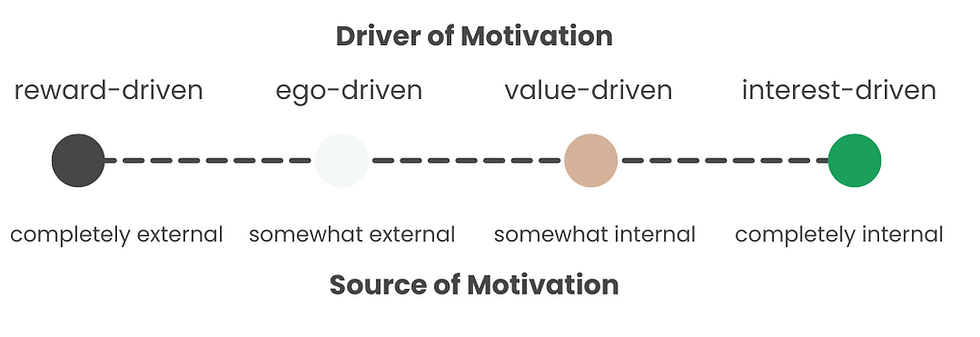
Reward-driven motivation: The student works only to earn a grade or avoid a punishment.
Ego-driven motivation: The student works primarily to avoid feeling guilty or ashamed, or to feel a sense of pride in front of others.
Value-driven motivation: The student works because they see it as personally important or valuable for their future.
Interest-driven motivation: The student works simply because the learning itself is enjoyable, exciting or deeply satisfying.
Does the driver matter?
Research has shown how different types of motivation relate to students’ academic performance, their mental well-being, and their persistence and effort in class. The table summarises the findings – if there is a positive link (+), a negative link (-) or no link (x).

Let’s see what this table tells us.
Reward-driven motivation: This type of motivation is not related to higher grades or success, is related to lower effort and persistence, and is linked to increased anxiety and negativity. The non-relation with good academic performance is because the student’s focus is on the “prize” (like a high grade) rather than the learning process itself. For example, a student might memorise facts for an exam but fail to build a deep understanding and so not do well on questions that assess understanding or application.
Ego-driven motivation: This type of motivation is not related to higher grades or success, is related to more effort but it is not consistent, and is linked to increased anxiety and stress.
Value-driven motivation: This type of motivation is related to higher grades or success, is strongly related to persistence, and is linked to a positive attitude toward school. It is interesting to note that students may put in some extra effort when driven by “ego” but this is not sustained. However, when students see the “why” behind their learning (value-driven), they show much higher intention to keep going, even when challenged.
Interest-driven motivation: This type of motivation is strongly related to higher grades or success, is related to active participation and initiative, and is strongly linked to overall wellbeing.
The crux of the matter is that internal – not external – motivation is clearly related to higher school grades. However, its importance goes far beyond the report card; developing a value-driven persistence will help to push through difficult tasks. Furthermore, learning because of interest is essential for a student’s mental well-being. These factors are vital for holistic development. Thus, supporting students’ internal drivers seems to be the missing key to unlock their true potential.
This brings us to the next logical question:
How can teachers increase students’ internal motivation?
As per the SDT framework, there are 3 needs that, when fulfilled, result in internal motivation in a person. Let us explore these in the context of a classroom with some strategies and simple examples that can help fulfil each need.
1. Competence: The need for students to feel confident and effective in their actions.
Provide meaningful feedback: Instead of saying, “You have not explained the quote,” say, “You have added a quote and linked it to the question. Can you add a couple of lines explaining how the quote proves your point?” This shifts the focus from "getting it wrong" to mastering a skill. This builds value-driven motivation as students see revision as a tool for their own growth.
Give solvable problems: Instead of giving a very difficult problem, give a scaffolded set: three practice questions that rise in difficulty so that students feel confident to handle the more difficult question. When moving up challenges, students are more likely to experience the “thrill of solving” that will spark interest. If a problem is too difficult, they will lose interest.
Appreciate effort (not only results): When students revise their work after your feedback, compliment them. Reinforce that the process of learning is what is truly valuable. Students develop a value-driven mindset and view hard work as a virtue that is worth their time.
[There is more on this as well as how to support students to feel more confident in the online, self-paced TEPS Course How to Motivate Students and Keep Their Attention.]
2. Autonomy: The need for students to feel they are engaging in learning voluntarily and freely, rather than being controlled.
Provide meaningful choices: Instead of simply assigning a task, offer two ways to complete it, such as writing a letter to a historical figure or creating a comic strip of the event. Offering a choice of format will increase interest-driven motivation by letting students lean into their creative strengths.
Consider pupils’ opinions: Before starting a unit on sustainability, for example, ask the class: “Which local issue should we focus on: waste management in our colony or water conservation at school?” When students feel their voice matters, they develop value-driven motivation since the topic becomes "their project," making their effort more relevant.
Refrain from controlling language: Instead of “You must finish all questions now," try, “Start with the hardest question while I’m here to help.” Lower the pressure of external control and create room for interest-driven motivation. The students will then engage out of a genuine desire to learn.
3. Relatedness: The need for students to feel a sense of belonging and a secure connection with their teachers and peers.
Build a strong classroom community: Conduct collaborative projects where every student has a unique, essential role (e.g., researcher, illustrator, presenter). Having a defined role will help develop interest- and value-driven motivation. Students won't want to let their peers down and will work to “support the community.”
Manage your own emotions: When a student talks out of turn, say “Pause. We agreed on one voice at a time. You’ll speak after Aarav. Thank you.” instead of “Why are you always talking over others? It’s so rude – I’m fed up!” A teacher who remains calm makes the class feel safe. This allows students to develop interest-driven motivation because they feel safe enough to be curious, rather than afraid.
Connect with students: Learn one "non-academic" fact about each student, such as their favourite sport or hobby, and mention it in passing or use it as a context for a word problem. This will help build value-driven motivation as students will feel “seen”. They will develop a sense of self-worth since their teacher is interested in their personal aspirations.
[There is more on this in the online, self-paced TEPS Course Classroom Management.]
These are just some examples. Surely, teachers will be able to find more ways to fulfill these needs in their classrooms. Please share your ideas by writing to us at info@things-education.com.
As for us, we sign off with the main takeaway: Educators need to think about fostering internal motivation and moving students beyond mere compliance toward a state where they value their education for its own sake!
If you found this newsletter useful, please share it.
If you received this newsletter from someone and you would like to subscribe to us, please click here.
Edition: 5.06


Comments