
Vocabulary matters…
- Things Education

- Jun 19
- 6 min read
…in learning science.

Hello all. Welcome to the 171st edition of TEPS Weekly!
A Grade 2 teacher places different leaves on each table and says, “Observe the leaves carefully and share your observations.” At first, many students look at the leaves quickly and give simple responses: “This one is big,” or “This one is green.”
The teacher then pauses and explains, “In science, observing does not mean just looking. It means looking carefully and noticing details. When we observe, we look for shape, colour, size, lines, texture, smell and patterns.” Suddenly, the nature of the task changes. Students look again, but this time with more attention. Now the responses become richer: “The edge is not smooth; it has small teeth.” “This leaf feels smooth, while this one is rough.” “The lines are going from the middle to the sides.”
What changed here? Students’ understanding of one scientific word: observe.
This is why science vocabulary matters. When students understand the language of science, they learn how to think, read, explain and investigate like young scientists.
But first, what do we mean by science vocabulary?
Science vocabulary is not just a list of difficult words given at the beginning of a chapter. It is a medium to understand and express scientific ideas.
Science vocabulary is divided into three broad groups: Tier 1, Tier 2 and Tier 3. This is based on specificity, ranging from everyday vocabulary to topic-specific vocabulary.

There is another important category: polysemous words. These are words that have one meaning in daily life and a different or more specific meaning in science. Examples include force, work, release, matter and energy.
In everyday language, force may mean strength, pressure or making someone do something. In science, force means a push or pull that can change the motion or shape of an object. If this difference is not made clear, students may think they understand the word because it sounds familiar but they may misunderstand the concept.
Why should we teach science vocabulary?
1. To develop scientific thinking
Science requires thinking in a certain way. To do this well, students need the language of science. The Grade 2 leaf example shows this clearly. Without such vocabulary, students may have ideas but struggle to organise them. For example, in an experiment on plants kept either in the dark and in sunlight, a student may say “I think this plant will grow better” (the student is referring to the plant kept in sunlight). But after learning the word predict (scientific meaning), the student says “I predict this plant will grow better since plants need sunlight for growth.” This builds scientific temperament since the student is reasoning, not guessing.
2. To help students read science
Science text may include several unfamiliar terms, academic verbs and abstract ideas. This might make some students anxious, and they might stop reading carefully. Teaching key vocabulary helps students approach science texts with more confidence. They can then focus on the concept without feeling stuck at every sentence.
3. To deepen conceptual understanding
Scientific words carry the meaning of a concept, process or relationship. Words like adaptation are not useful if students only repeat them. Many scientific ideas are abstract. We cannot always see gases, particles or energy. Clear vocabulary helps students hold these ideas in their minds and connect them. When teachers unpack science vocabulary carefully, abstract ideas become more accessible.
4. To prevent confusion
Many scientific words also have everyday meanings. A familiar word is not always an easy word. A good example is the aforementioned force. If teachers do not explain the shift of meaning from regular conversations to science, students may misunderstand the concept even though the word sounds familiar.
How can we teach science vocabulary?
Teaching vocabulary does not mean asking students to copy definitions from the textbook. One of our previous editions covered some strategies for teaching vocabulary in the early years. All of them can be used for science vocabulary building as well.
Here, we will list science-specific strategies teachers can use. Some have examples from primary and some from secondary grades, but most of these strategies can be modified for almost any grade level.

1. 4. Use the Frayer Model
The Frayer Model helps students understand a scientific word deeply, not just memorise its definition.
Students divide a page into four parts: definition, characteristics, examples and non-examples. The non-examples are also very useful since they reveal any misconceptions. For example, a student makes a model for adaptation. The Frayer Model is useful for words that students often use loosely or misunderstand.
2. Use physical response
In this method, students connect physical movement with science vocabulary. This is especially useful when the word involves movement, position, direction or process.

For example, the teacher says, “Today we will learn two scientific words with movement.” For rotation, each student stands in one place and slowly turns around on the spot. The teacher says, “When an object spins around its own centre, we call it rotation.” For revolution, one student stands in the centre as the sun. Another student walks in a big circle around the sun. The teacher says, “When an object moves around another object, we call it revolution.” These two words are often confused. Movement makes the difference clear and memorable.
3. Use visual tasks
Visual tasks help students show the meaning of a word through drawing, labelling, demonstration or representation. This supports deep understanding because students must think about what the word actually means.

For example, when teaching the word habitat, the teacher shows pictures of a fish, camel and bird. She explains, “A habitat is the place where a living thing gets what it needs to live.” Then, students choose one animal and draw where it lives. For example, a student drawing a camel may show a desert, sand and dry plants. Through this task, students understand that a habitat provides what a living thing needs to survive.
4. Use context setting
Students learn new vocabulary better when it is connected to something they already know.

For example, the teacher writes “thermometer” on the board and breaks it into parts. She connects thermo to a daily object. “A thermos helps keep hot drinks hot or cold drinks cold for a longer time. So, when we see thermo in a word, it usually has something to do with hot or cold.” Next, she discusses the word meter. Students may know that a metre is a unit of length. The teacher connects this and mentions that the word meter is also used for a measuring tool. The teacher then explains, “A thermometer is a tool that measures how hot or cold something is.” This kind of context helps students see that scientific words have parts that give clues to their meaning.
5. Use rich language connections
Rich language connections involve helping students understand a word through its origin or structure.

Etymology means the history or origin of a word. For example, the teacher writes geology on the board and explains its origin. The teacher can then connect this to other words, like biology. Students see that many scientific words have meaningful roots.
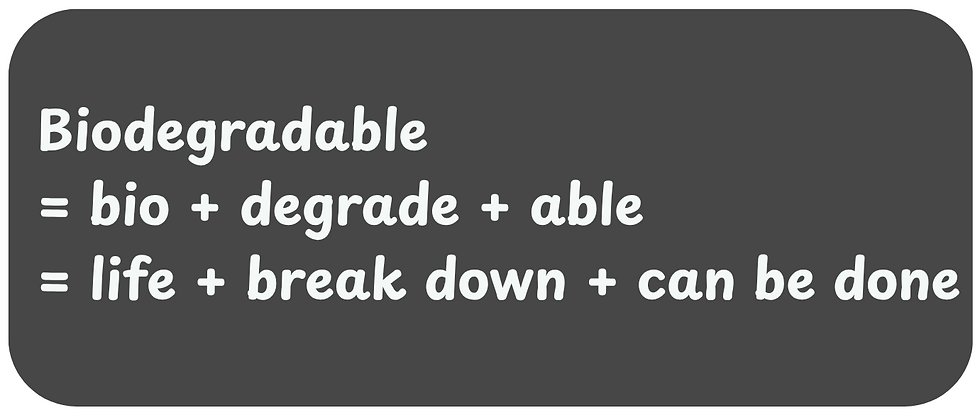
Morphology means the structure of a word, including prefixes, roots and suffixes.
For example, the teacher writes biodegradable and breaks it down. So, biodegradable means something that can be broken down by living things. This strategy tells students that difficult words can be decoded from their parts.
It also helps teachers build word families. For example, biodegradable can be taught with biodiversity, biology and biosphere.
6. Use semantic feature analysis
Semantic feature analysis involves comparing related words using a table. It is especially useful when students confuse words from the same topic.
For example, students often confuse element, compound and mixture. Instead of teaching each word separately, the teacher can guide students to create a comparison table.

Such tables help students clearly see similarities and differences. This is much more effective than asking students to memorise three separate definitions.
A closer look at these strategies shows that teaching science vocabulary is deeply connected to concept learning.
Thus, vocabulary instruction should be treated as part of the real lesson. At the same time, teachers can benefit from planning separate vocabulary sections before a topic or unit. This is especially useful when a unit has many new terms, word families or confusing everyday words. For example, before a unit on environment, a teacher may choose to teach the words biosphere, biodiversity and biodegradable together. This helps students see connections between words and concepts.
When it comes to science, vocabulary matters. It is what gives students access to the ideas, methods and habits of science.
If you found this newsletter useful, please share it.
If you received this newsletter from someone and you would like to subscribe to us, please click here.
Edition: 5.26


Comments